


.svg)


Can I Get an Education Loan Without a Co-Applicant in India?
Pursuing higher education often requires financial support, that is provided by education loans. Yet many aspiring students face hurdles due to the requirement of a co-applicant for these loans.
Thus, there is a growing demand for education loans without the necessity of a co-applicant, offering greater accessibility and independence to students.
Let's dive into the landscape of education loans without co- applicant, exploring the availability, eligibility criteria, and benefits of such loans.
Key Takeaways
- No-co-applicant education loans are growing in demand, with approvals based on academic performance, reputed institutions, future earning potential, or collateral.
- Small loan amounts (₹4–7.5 lakhs) may not require a co-applicant.
- Ideal for students with unemployed/retired parents or low CIBIL co-applicants, provided they have strong academics or work experience.
- Lenders like Propelld sanction loans with no co-applicant, based on the student’s marks and future earning potential — up to ₹1 Crore (study abroad) and ₹40 Lakhs (domestic), collateral-free.
What is a Co-Applicant or a Co Signer?
A co-applicant in a loan is an individual who applies for the loan alongside the primary borrower, sharing responsibility for repayment.
A co-applicant is also known as a cosigner or co-borrower. They typically provide additional guarantees in the form of financials or assets to strengthen the loan application.
Types of Co-Applicants
There are 2 types of co-applicants:
1. Primary Co-Applicant
The primary co-applicant is a vital individual in your education loan process whose participation is mandatory when you take the loan. The primary applicants are your parents or siblings. They may be working or retired. It's not necessary for them to have a stable financial status.
2. Financial Co- Applicant
The financial co-applicants are the additional co-applicants with strong financial profiles to strengthen the guarantee of loan repayment.
Financial co applicants must be in blood relation: first cousins, maternal, paternal uncles, aunts, etc. They are required only if the primary co-applicants are not sufficient for the financial guarantee, usually in cases where the primary applicants don't have a stable income.
Difference Between a Primary and a Financial Co Applicant
The roles of a Primary Co-Applicant and a Financial Co-Applicant differ in terms of responsibility, income consideration, and liability. The table below highlights the key differences between the two:
|
Primary Co-Applicant |
Financial Co-Applicant |
|
A person who applies for the loan alongside the primary applicant, sharing joint responsibility. |
A person who provides financial support to the primary applicant, helping improve the chances of loan approval. |
|
Has a more involved role in the loan application process, usually with equal responsibility. |
Primarily serves as a secondary support to strengthen the loan application. |
|
The income of the primary co-applicant is considered alongside the primary applicant’s income for loan approval. |
The co-applicant’s income supplements the primary applicant’s income, often used to meet loan eligibility. |
|
Shares responsibility for the loan repayment, with equal accountability in case of default. |
Shares liability for loan repayment, especially if the primary applicant defaults. |
|
The primary co-applicant’s financial situation directly impacts loan approval. |
The financial co-applicant helps increase the loan approval chances, especially if the primary applicant has a weaker financial profile. |
Who Can Be Co Applicant For an Education Loan?
Various family members or guardians can qualify as co-applicants, depending on the lender's criteria and their financial ability.
- Parents (Father or Mother): They are the most preferred co-applicants due to stable income and legal responsibility.
- Spouse: For married students, a spouse can be a co-applicant.
- Siblings: Brothers or sisters can co-apply if they have the financial ability.
- Legal Guardians: If parents are unavailable, a guardian can be a co-applicant if meeting the lender's terms.
- Extended Relatives: Some lenders accept close relatives like paternal or maternal uncles or aunts with a stable income.
- Other Blood Relatives: First cousins or other family members may also qualify if they fulfill financial and document criteria.
Get a no collateral Education Loan
Why Do Most Lenders Ask for a Co Applicant for an Education Loan?
For most traditional lenders, a co-applicant serves as a crucial element in the education loan application procedure. This person—who co-signs the loan agreement with the primary applicant (the student)—shares equal responsibility for repayment. However, their role is not merely formal; it carries significant implications.
Most lenders ask for a co-applicant for an education loan because it provides the lender with an additional layer of financial security. Here's why many lenders require a co-applicant:
Credit Risk Mitigation
The co-applicant helps to mitigate the bank's risk by providing additional financial security, especially when the primary applicant is a student without a credit history or stable income.
Improved Loan Approval Chances
Having a co-applicant, typically a parent or guardian, increases the chances of loan approval as it assures the lender of repayment capability.
Higher Loan Amount
With a co-applicant, the loan amount can often be higher, as the combined income and assets improve the applicant's ability to repay.
Repayment Guarantee
In case the primary applicant is unable to repay, the co-applicant becomes responsible for the loan repayment, reducing the lender's risk.
Strengthening the Loan Profile
A financially stable co-applicant strengthens the overall loan profile, making the application more favorable to lenders.
That said, this is the norm for traditional lenders — new-age NBFCs like Propelld sanction loans without a co-applicant, based on the student's marks and future earning potential.
Education loan - 2 Days Approval. 3 Steps Process. 4 Documents Required
Eligibility Criteria for Education Loan without Co Applicant
The table below highlights the main factors lenders assess for loan approval without a co-applicant.
|
Eligibility Criteria |
Details |
|
Student's Age |
Typically, the student must be between 18 and 35 years old at the time of applying. |
|
Academic Qualification |
The student should have secured admission to a recognized institution (preferably for premium courses). A good academic record increases the chances of approval. |
|
Loan Amount |
For small loan amounts (generally below ₹4-7 lakhs), some lenders may waive the co-applicant requirement. |
|
Course of Study |
Loans for courses from reputed institutions (like IITs, IIMs, or top foreign universities) may not require a co-applicant, including education loans for MD MS. |
|
Collateral |
If the student offers sufficient collateral (property, fixed deposits, etc.), the need for a co-applicant can be waived. The value of the collateral should generally cover the loan amount and interest. |
|
Income Source |
The student should have a stable income or financial backing (in the case of an independent borrower). Some lenders may require proof of a steady income stream or employment offer post-study. |
|
Repayment Capacity |
The lender assesses the student’s potential to repay the loan, based on their academic course, future earning potential, and employability. |
Let's see a few cases of where you might or might not be eligible for education loan without a co applicant:
Can I Get an Education Loan if My Father is Retired?
Even if your father is retired, you may still qualify for an education loan, especially if he has a stable income source like a pension or other savings. Lenders typically assess the overall financial situation of the co-applicant. If your father's pension is sufficient to cover his living expenses and the loan repayment, many lenders will still approve the loan.
However, if his income is insufficient, you may need to explore other options, such as securing a loan with a different co-applicant or offering collateral.
Thats not all. Many new age lenders like Propelld provide an education loan that does not require a co-applicant, with approval based on the student's marks and future earning potential.
Can I Get an Education Loan if My Father's CIBIL Score is Low?
A low CIBIL score of your father can complicate the loan approval process with traditional lenders, as it reflects past creditworthiness and may signal a higher risk.
With most banks, a stable co-applicant income or sufficient assets can help counterbalance a low credit score.
Lenders like Propelld sidestep this entirely by not requiring a co-applicant — approval is based on the student's marks, the institution, and future earning potential.
Can I Get an Education Loan Without a Guarantor?
It is possible to get an education loan without a guarantor or a co applicant? Particularly if the loan amount is small, or with new-age NBFCs that approve on student potential.
Well, yes, it is possible. Many lenders, particularly the new age NBFCs like Propelld, offer loans without a guarantor or co-applicant, especially for those with a good academic track record.
However, government banks and larger loans often still require a guarantor, especially when the loan amount exceeds a certain limit.
Can I Get an Education Loan if My Parents are Unemployed?
If your parents are unemployed, securing an education loan from a traditional lender can be more challenging, as banks often look to the co-applicant for repayment assurance. With most banks, a financially stable relative or guardian acting as a co-applicant, or collateral, helps improve your chances.
NBFCs like Propelld consider your academic background and potential for future earnings and do not require a co-applicant.
Can I Get an Education Loan Without Collateral and Co Applicants?
Generally, most banks require either a co-applicant or collateral for higher loan amounts. However, new-age NBFCs like Propelld approve loans without collateral or a co-applicant, based on the student's academic record, institution, and future earning potential. For smaller education loans—typically under ₹7.5 lakhs—some banks may also waive collateral or co-applicant requirements.
For higher amounts at traditional banks, collateral is usually necessary, or the applicant must have a co-applicant with a strong financial background.
Can I Get an Education Loan Without ITR?
Yes, you can get an education loan without an Income Tax Return (ITR), especially if applying without a co-applicant. Some lenders, like Propelld, approve loans based on academic performance and university ranking instead of strict financial documentation, making it easier for students without ITR to secure funding.
Can International Students Get a Loan Without a Cosigner?
Securing a loan without a cosigner can be challenging, but options exist. Many lenders offer loans based on university ranking and future earning potential rather than requiring a guarantor. Propelld provides flexible loan solutions for studying abroad, offering merit-based approvals and repayment flexibility without requiring a co-applicant, based on the student's marks and future earning potential.
Documents Needed for an Education Loan without Co-Applicant
Here is the outline of documents needed to secure an education loan without financial co-applicant:
|
Category of Documents |
Description |
|
Official University Documents |
Official letter from the university that mentions the tuition fees. |
|
Academic Documents |
All relevant academic records and certificates. |
|
Employment Documents |
Proof of current or previous employment, if applicable. |
|
Visa Documents |
Valid visa-related documents as per requirements. |
|
KYC Documents |
Primary identification for the applicant (PAN Card, Aadhaar Card, passport). |
|
Secondary Photo ID |
Secondary identification from the applicant's home country. |
|
Savings Account Details |
Bank account details of the applicant. |
|
Address Proof |
Proof of residence, including documents like an electric bill. |
Note: For lenders that require a co-applicant, additional income proof (ITR, salary slips, or business financials) of the co-applicant is also needed. With Propelld, no co-applicant income documents are required.
Too much documentation that is?
No worries! Enjoy hassle free and simplified loan processing with Propelld Education Loan .
How to Get an Education Loan Without a Co Applicant in India?
Getting an education loan without a co-applicant requires a structured approach. Follow these steps to secure a loan independently:
1. Research and Identify Suitable Lenders
Begin by researching banks, financial institutions, and NBFCs (Non-Banking Financial Companies) in India that offer education loans without the need for a co-applicant.
2. Compare Loan Offers
Evaluate different loan options based on interest rates, repayment tenure, loan amount limits, processing fees, and other features. Look for lenders who have a history of approving loans without a co-applicant for students with strong academic records or collateral.
3. Gather Necessary Documents
Once the lender is finalized, collect all the required documents, including KYC, proof of admission, income documents, and collateral (if required).
4. Apply
Fill out the online application form available on the lender's website. Some lenders may also allow offline applications, but applying online is generally quicker and more convenient.
5. Submit Documents
Upload the required documents along with the application form, including academic records, proof of admission, income proof (if applicable), and collateral documents (if required).
6. Loan Application Review
Once the application is submitted, the lender will review your profile and documentation. This may include verifying the authenticity of your academic credentials and other submitted details.
7. Loan Processing
After reviewing your application, the loan will be disbursed and, in most cases, is paid directly to the college.
Can You Get an Education Loan Without Collateral or a Co-Applicant?
For Indian students planning higher studies abroad, most banks and NBFCs usually require either a co-applicant or collateral. This becomes a big hurdle for those without family income support or property to pledge, even if they're financially stable on their own.
A Reddit user shared their case:
“I'm 28, earn ₹10 LPA with 5.5 years of work experience, and want to pursue a master's in France. But I don't have a co-applicant or collateral. I need a loan of ₹5–20 lakh—what are my options?”
This is a common roadblock. Traditional Indian banks often reject such cases. However, new-age NBFCs like Propelld — along with some international lenders — provide no-collateral, no-co-applicant loans based on the student's potential.
Possible way forward:
- Consider a lender like Propelld that approves on student potential without a co-applicant
- Compare lenders carefully before committing
- Review repayment terms in detail
Keep income and financial records ready to boost approval chances.
3 Scenarios When You can Get an Education Loan Without a Co Applicant
Below are three situations where a co-applicant may not be necessary:
1. NBFCs and Government Lenders
Some new age NBFCs in India, such as Propelld, offer education loans without requiring a co-applicant, especially for students with strong academic records and admission to recognized institutions. These loans are generally offered for courses that have a good return on investment and strong career prospects.
2. Work Experience
If you have prior work experience or have secured a job offer from a reputable company, lenders may consider your professional background and financial independence. In such cases, the loan can be approved without the need for a co-applicant, as your work experience demonstrates your ability to repay the loan.
3. International Lenders
International lenders or financial institutions offering education loans to students pursuing higher education abroad may not require a co-applicant. This is especially true for high-demand programs at well-known universities, where the potential for post-graduation employment is high, and the loan is considered a low-risk investment.
Which Bank Gives Education Loan Without Co Applicant In India?
In India, it is generally challenging to get an education loan from a traditional bank without a co-applicant, because banks typically require one for added security, as students alone usually lack financial stability to guarantee repayment.
Most major banks do not offer education loans completely without a co-applicant for domestic loans. New-age NBFCs like Propelld are the exception — they sanction loans without a co-applicant, based on the student's marks and future earning potential. International lenders for overseas studies are another option for no-co-applicant loans, though usually at a higher cost and with currency risk.
Education Loan Without Co Applicant Lenders in India
Among the few, Propelld is one such lender that provides hassle free education loans without co applicant.
Instead of relying on a financial co-signer, Propelld considers factors like academic performance and future earning potential to approve loans. Propelld offers up to ₹1 Crore for study abroad and up to ₹40 Lakhs for domestic courses — collateral-free, with no co-applicant, 0% margin (100% of fees financed), and instant approval in 48 hours. The process is quick, hassle-free, and designed to help students fund their education without unnecessary delays.
With flexible repayment options, competitive interest rates, and fast disbursals, Propelld is a great choice for those looking for an education loan without a co-applicant.
No Cosigner Student Loans for International Students
Traditional student loans in countries like the USA or Canada typically require a local cosigner—someone with good credit who is a citizen or permanent resident and agrees to repay the loan if the student cannot. Many international students, however, lack access to such cosigners.
To overcome this obstacle, some lenders and financial institutions now provide student loans tailored for international students that do not require a cosigner. Instead of relying on credit history or a local guarantor, these loans evaluate factors such as the student's academic achievements, future career potential, and expected earning capacity after graduation.
Education Loan for Study in USA without Co Signer
International students planning to study in the U.S. can explore education loan options that do not require a cosigner. Below is a summarized comparison of key aspects:
|
Category |
Details |
|
Eligibility Criteria |
Students from specific countries; admission to eligible U.S. universities and graduate programs; academic performance and career potential are considered. |
|
Loan Features |
Loan amounts vary; interest rates generally fixed or variable; typical repayment terms of 7–15 years; grace periods of 6–12 months; limited to supported schools and programs. |
|
Application Process |
Online application; upload documents (passport, admission letter, academic records, income proof if applicable); timelines range from 1–4 weeks for approval. |
|
Benefits & Risks |
Pros: No U.S. credit history or cosigner required. |
Education Loan for Study in Canada without Co Signer
International students aiming to study in Canada have access to a limited but expanding range of no-cosigner loan options. Here's a structured overview:
|
Category |
Details |
|
Availability |
Fewer loan options compared to the U.S., but increasing support from global education loan providers. |
|
Eligibility & Terms |
Loans available for select universities and graduate programs; based on academic merit, projected income; includes loan caps and some repayment flexibility. |
|
Tips for Applicants |
Maintain strong academic records; choose in-demand programs; show career potential and earning outlook to improve approval chances. |
|
Comparison with U.S. Loans |
Canadian loans may have different interest structures, often shorter grace periods, and varying repayment plans compared to U.S.-based options. |
Benefits of Getting an Education Loan without Co Applicant
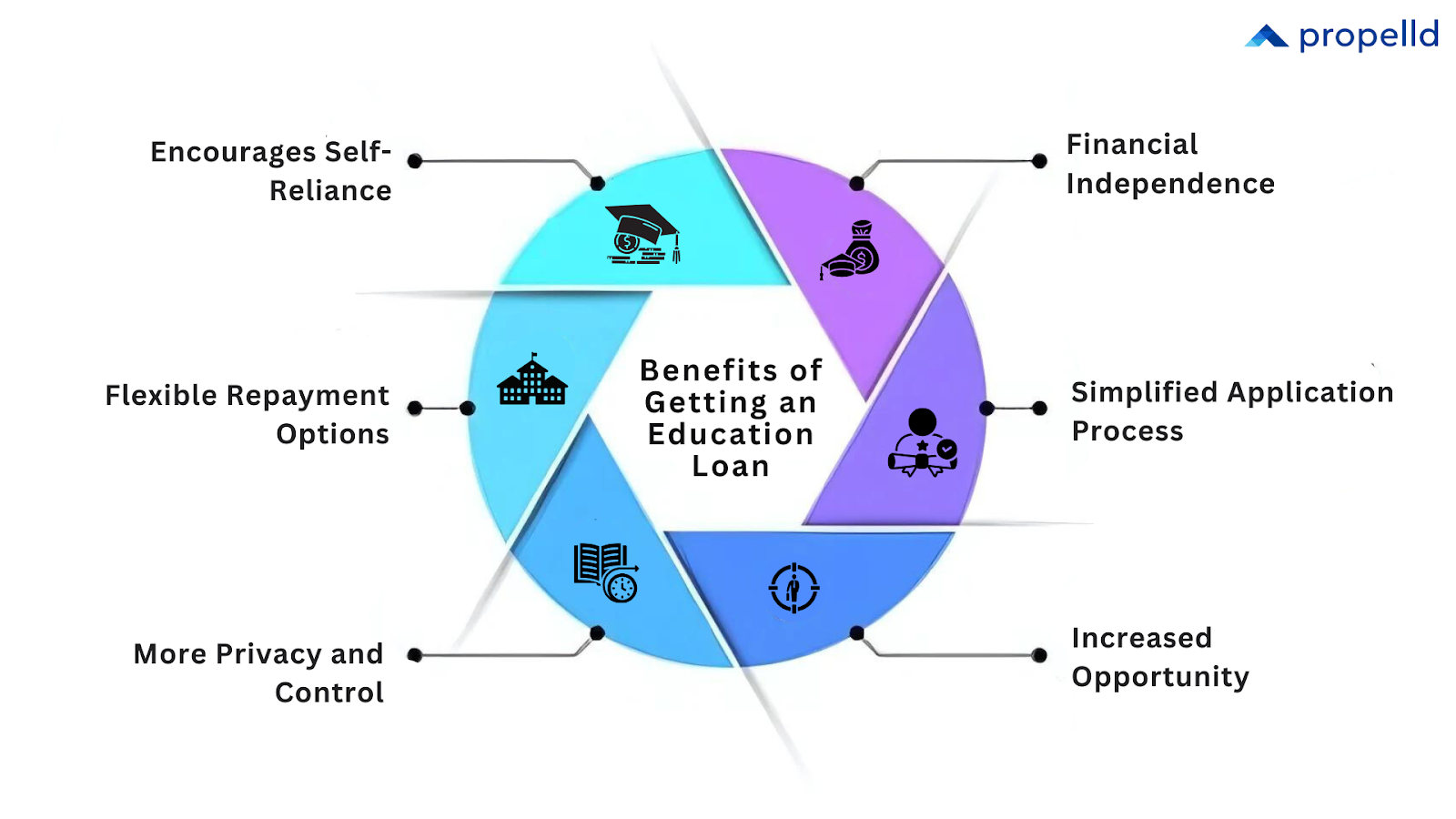
Taking an education loan without a co-applicant comes with several benefits, especially for students who want financial independence or don’t have someone to back their application. Here’s why it can be a great option:
1. You Don’t Have to Depend on Anyone
Getting a loan on your own means you don’t need to rely on your parents, relatives, or anyone else to support your education financially. This gives you complete control over your finances from the start.
2. Faster and Easier Loan Process
When you apply for a loan without a co-applicant, the approval process is much simpler. You don’t have to worry about someone else’s credit score, income proof, or financial documents, making the entire process quicker.
3. A Great Option for Students with No Financially Strong Co-applicant
Not everyone has parents or guardians with a good credit score or stable income. A no co-applicant loan ensures that your education isn’t affected just because your family may not have the financial backing required by traditional banks.
4. Full Control Over Your Loan and Repayments
Since you’re the only one responsible for the loan, you have the freedom to decide how to manage your repayments. There’s no pressure from anyone else to follow their financial plans or preferences.
5. No Risk to Family Members’ Credit or Assets
If a co-applicant is involved, their credit score and financial stability are on the line if you ever struggle with repayments. By taking a loan independently, you ensure that no one else is affected by your financial decisions.
6. More Privacy in Your Financial Matters
Since no one else is involved in the loan process, your financial details remain private. You don’t have to disclose your loan status or repayment details to anyone unless you choose to.
7. Flexible Repayment Plans
Many lenders who offer loans without co-applicants provide flexible repayment options, allowing you to choose a schedule that works best for your financial situation. Some even offer the option to make prepayments without extra charges.
8. Builds Your Own Credit Score
By handling a loan on your own and making timely repayments, you start building your credit history early. This helps when applying for future loans, credit cards, or even renting a house.
Not just that, some NBFC education loans come even without collateral and provide a flexible and quick financing option for students pursuing higher studies.
Find out if you qualify for an unsecured education loan without a co-applicant easily here.
Obtaining a student education loan without a co-applicant is achievable if you have correct knowledge about its eligibility and approval process. Every student has a unique set of challenges, and lenders often reject loan applications without collateral and co-applicants.
If you are sailing the same boat, start your education loan process with us today.
At Propelld, we offer a super easy loan through a private and student-friendly loan process that can focus on your education loan without worrying about the loan hassles.


